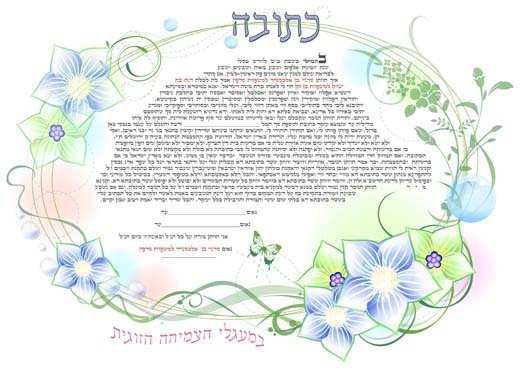
A ketubah is a Jewish halakhic legal document given to the bride prior to marriage. Today, it is customary to present it during the chuppah (wedding canopy ceremony). The original purpose of this agreement was to protect the rights of the woman.
In the agreement, the husband undertakes to feed, support, and honor his wife (based on the verse "her food, her clothing, and her conjugal rights he shall not diminish" — Exodus 21:10). The ketubah specifies the sum the husband commits to pay his wife in case of divorce or his death. It also lists the assets the woman brings from her father's house, which the husband holds partial rights to but which remain her property (nikhsei melog and nikhsei tzon barzel — "melog" and "iron flock" assets). The minimum amount for a ketubah is 200 zuz (a Mishnaic and Talmudic-era currency) for a virgin bride, and 100 (also called a maneh) for a widow or divorcée. In modern currency, 200 zuz equals roughly a year's salary. Two qualified witnesses sign the ketubah document.
The witnesses must also be present when the groom hands the ketubah to the bride. Some have the practice (and this is now common in most ketubot under the various local rabbinates) for the groom to add his signature as well, although according to the original ordinance, the ketubah is a confirmation of the husband's verbal commitment before the witnesses. After the ketubah is given, the bride entrusts it to her mother until after the wedding ceremony. Once she arrives home, she must store the ketubah in a safe place where it will not be lost; the duty of safekeeping rests with her. According to rabbinic ordinance, the couple may not stay together without a ketubah. If the ketubah is lost, they must write another, called a ketubah de'irkasa ("lost ketubah"). In practice today, a copy of the ketubah is made at the time of the chuppah and kept in the rabbinate's offices in case the original is lost. Among various Jewish communities, a custom developed for the bride to keep the ketubah at her father's house, to safeguard it from the husband should the relationship deteriorate. Halakhically, however, this is not necessary, since at the moment of commitment the husband cannot withdraw from his obligation; preferably, the ketubah is kept in the couple's home.
The ketubah is not mentioned in the Hebrew Bible. According to most opinions, it was instituted by the sages of the Oral Torah to protect women, so that they could not be easily divorced — since one who divorces his wife must pay her a substantial sum. According to certain views, the obligation of the ketubah derives from the Torah itself, and the sages only instituted the prohibition of cohabitation without a ketubah. Shimon ben Shetach instituted that all of the husband's real estate would be lien-bound to the ketubah, meaning the wife could collect the debt in the event of divorce from any of her former husband's real estate (Talmud, Ketubot 82b). Beginning with the Geonic ordinance, a ketubah may also be collected from non-real-estate assets. The man's sons are also bound by the ketubah after his death — a remnant of an era when property belonged exclusively to men, and a widow could be left destitute.
The earliest ketubah was discovered in Maresha in 1993, on a 10×14 cm pottery shard. This ketubah, dated to 163 BCE (Second Temple period) and written in Aramaic, closely resembles modern ketubot. Researchers believe it may have been a draft of a ketubah rather than an actual one.
Throughout history, with the dispersion of the Jewish people in the diaspora, different versions were established in various communities — primarily reflecting additional obligations adopted in those communities and varying halakhic interpretations. The laws of the ketubah are detailed in the Talmud (Tractate Ketubot), in Maimonides' Mishneh Torah (Laws of Marriage), and in the Shulchan Aruch (Even HaEzer).
Today, the ketubah is gradually losing its substance as a legal document, due to the changing nature of life and various civil laws. The Spousal Property Relations Law (5733-1973) determines that each spouse is entitled to take with them, upon separation, all assets they brought into the relationship. Additionally, each spouse is entitled to half of the assets accumulated during their joint partnership.
Only on rare occasions does a wife actually claim her ketubah (i.e., the sum to which the husband committed). According to court rulings, the ketubah constitutes a binding legal document; however, since the source of the obligation to write a ketubah is religious law, the obligation itself is to be adjudicated according to the rules of Jewish law. Although the ketubah is a binding document, rabbinic court rulings have established that if it specifies an unrealistic sum the husband cannot meet, the court may intervene to reduce it. Nevertheless, the Beersheba rabbinic court ruled to pay a ketubah of one million NIS in a case where a husband betrayed his wife, rejecting the husband's claim that he "wrote it as a joke." A sum that is too small is also illegal. To avoid the awkwardness of seemingly stating the bride's worth in the groom's eyes, rabbis sometimes refrain from announcing the exact amount publicly and instead say "such-and-such shekels."
In wedding ceremonies of the Progressive (Reform) Judaism movement, it is customary to shift the emphasis of the ketubah. The ketubah becomes a document designed and planned by both partners under the rabbi's guidance. In the document, both partners declare equally their love, their intention to establish a Jewish home, and the principles that will guide their lives. This ketubah is usually written in the local language, in contrast to the traditional ketubah written in Aramaic.
(Adapted from the Wikipedia entry "Ketubah")
Frequently Asked Questions
What is a ketubah?
A ketubah is a Jewish legal-halakhic document that the groom gives to the bride at the wedding ceremony. Its purpose is to obligate the husband to provide for the wife and protect her rights in case of divorce or his death.
When is the ketubah given?
Today, the ketubah is given during the wedding ceremony itself, before the ring kiddushin. In the past, it was given before the marriage.
What is the amount in a ketubah?
The minimum amount is 200 zuz for a virgin and 100 (maneh) for a widow or divorcee. 200 zuz was equivalent to roughly one year salary in Mishnaic and Talmudic times.
Who signs the ketubah?
Two valid witnesses sign the document. They must also be present when the groom hands the ketubah to the bride.
Is the ketubah still valid today?
Yes. The ketubah is an essential part of Orthodox and Conservative weddings. In Israel, it is required by the Chief Rabbinate as a condition for marriage registration.