After listing all the amounts, all amounts are summed into one total.
Date and Place of the Ketubah:
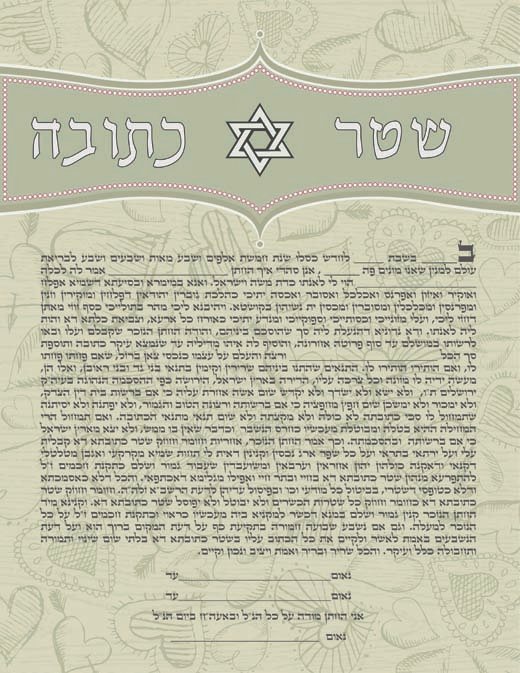
On the ___ day of the week, the ___ day of the month of ___ in the year ___ from the creation of the world, by the count we use here in the city of ___
The Wife's Maintenance
The maintenance obligation includes care for the wife's material existence. The obligation includes, in addition to food, also providing clothing and lodging — i.e., garments, a place to live, and medical care.
How ___ said to the virgin ___, "Be my wife according to the laws of Moses and Israel, and I will work and honor you, and I will give you sustenance and provide for you, in the manner of the men of Israel who work and honor and feed and provide for their wives in truth."
Ketubah Sum and Additional Ketubah
The Ketubah money ("mohar habetulot" — bride-price of the virgins) is a sum set by the Sages. If the marriage breaks up due to the husband (via a get / divorce), or upon his death, the woman receives the sum. This payment was set in order to protect the woman, so that it would not be easy in the husband's eyes to divorce her, and it was extended also to the case of his death. The sum is "200 zuz" — an amount of money on which one could live for one year. The value of the minimum sum is set according to local custom and the value of the currency. To the Ketubah it is possible to add an additional sum of money. By the strict letter of the law, it is not possible to compel the husband to add, but here too local custom is followed. On the basis of this halakha, the Chief Rabbinate sets, from time to time, the minimum sum, which includes the Ketubah and the addition to the Ketubah together.
And I give you the bridegroom's gift of two hundred silver dinars, due to you according to the Torah, and your sustenance, your clothing, and all your needs, and to come to you in the way of all the land.
Dowry and Additional Dowry
The dowry consists of the assets the woman brings with her at the time of her marriage. These assets are recorded in the Ketubah, and the husband takes upon himself the responsibility to return them upon the dissolution of the marriage according to their value at the time of the wedding. In the Ketubah according to the Sephardic custom it is written: "And the aforementioned groom acknowledged that he received them, and they came up and arrived in his hand and possession in full down to the last perutah, and he willed and assumed them upon himself as nikhsei tzon barzel ('iron-flock assets'), so that if they decreased — they decreased for him, and if they increased — they increased for him." In this formulation it is explicit that the groom accepts the dowry at the level of responsibility of nikhsei tzon barzel. An explanation of the concept will appear in the next chapter, "Duties and Rights in Marriage."
And ___ this virgin agreed to be his wife, and this is the dowry she brought him from her father's house — whether in silver, in gold, in jewelry, in garments, or in bedding items — a total of one hundred zekukim of pure silver.
The assets the woman brought and which were written in the Ketubah are the husband's responsibility. Other assets remain in the woman's possession, and the husband is permitted to trade with them. These assets are called nikhsei melog ("plucking assets"), and they will be explained in the next chapter. Since the husband is permitted to trade with his wife's assets, he assumes responsibility for an additional sum — "tosefet nedunya" (addition to the dowry). The Ashkenazi custom is to specify in the Ketubah a fixed sum, "two hundred zekukim of refined silver," without itemizing the sums in the local currency. If so written in the Ketubah, in the event of divorce the woman will claim a high sum, in accordance with the property she brought at the time of her marriage.
And the aforementioned groom willed and added to her, of his own, an additional sum of one hundred zekukim of refined silver opposite them, totaling two hundred zekukim of refined silver. And she further brought to him the sum of ________, and the groom added opposite them a third, amounting to the sum of __________.
In the Ketubah according to the Sephardic custom there is an addition: "And he shall not marry, betroth, or sanctify any other woman over her, except by permission of the Court of Justice." This addition is necessary because the cherem of Rabbeinu Gershom — which forbids marrying two women — applies only to Ashkenazi communities. This stipulation extends the prohibition also to those for whom the cherem does not apply.
The total of this Ketubah, this dowry, and this addition amounts to ______, apart from all her clothing, jewelry, and personal effects belonging to her.
Guarantees
The husband gives guarantees for the fulfillment of his obligations. He pledges all of his assets — those in his possession at the time of signing the Ketubah and those he will acquire in the future. Even "the cloak on his shoulder" is pledged to the payment of the Ketubah to the woman.
And thus said Mr. ___ the groom: "Responsibility for this Ketubah deed, and for the additions to the Ketubah, and the dowry, and the additions to the dowry — I have taken upon myself and upon my heirs after me, to be paid out of the best and most pleasing of my assets, and from every acquisition I have under the heavens and from what I will acquire in the future — both assets which bear responsibility (nikhsei dela nayadi — immovable property) and assets which do not bear responsibility (mitaltelin — movable property) — all shall be responsible and a guarantor for the payment of this Ketubah deed and the additions in it, and even the cloak on my shoulder shall be responsible for this payment, both during my lifetime and after my days of life, from this day and forever." And responsibility for this Ketubah deed, and these additions, the groom took upon himself with the stringency of all Ketubah deeds and additions customary among the daughters of Israel, made according to the institution of the Sages — not as an asmakhta (=a commitment not made wholeheartedly) and not as a tofes shtarot (=a deed written without commitment to execute it, but only for study).
Signatures
Signatures of witnesses and husband to verify all the obligations.
And we received a kinyan (act of acquisition) on this from ___ the groom to ___ the bride, on everything written and explicit above, with an instrument that is valid for performing acquisition with it — and all is firm and established. The statement of ___ son of ___, witness, and the statement of ___ son of ___, witness. I, too, the groom, acknowledge all of the above, and have come on the signature: ___ son of ___.
The Ketubah is read after the betrothal and before the marriage, and after it is read it is given to the wife. The reading time is set between the betrothal and the marriage in order to separate between the two, and to designate for each of them its own blessing of "Borei Pri HaGafen" (Creator of the fruit of the vine).
Frequently Asked Questions
What are the main components of a ketubah?
Date and location of writing, names of the bride and groom, the husband obligations, the amount (mohar and additional), itemization of dowry (nikhsei tzon barzel and nikhsei melog), and the signature of two witnesses.
What is "mohar habetulot"?
This is the basic amount set by the Sages — 200 zuz for a virgin, 100 for a widow or divorcee. It was meant to protect the wife in case of divorce or the husband death.
What is the difference between nikhsei melog and nikhsei tzon barzel?
Nikhsei melog assets remain in the wife ownership while the husband enjoys their fruits during marriage. Nikhsei tzon barzel enter the joint property, and the husband is responsible for preserving their original value to be returned upon divorce.
What is "tosefet ketubah"?
An additional sum beyond the basic mohar, agreed upon by both sides. It reflects the wife value in the husband eyes and can reach substantial amounts.
What does the husband commit to according to the ketubah?
The three basic obligations: sheerah (food and clothing), kesutah (lodging), and onatah (marital relations). Additionally, the obligation to honor and provide medical care in case of illness.