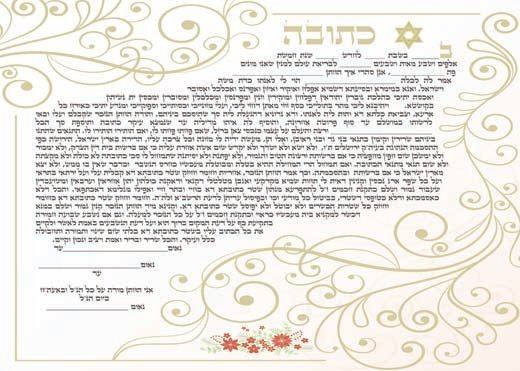
Does the Ketubah constitute a ceremonial element, or is it actually a legal contractual document of consequence?
Many couples tend not to attach importance to this, but the Ketubah signed by the groom has definite legal consequence — a wife can, upon termination of the marriage, demand payment of the sum the groom committed to in the Ketubah.
The Ketubah is a kind of financial agreement, created mainly as the husband's obligations to his wife: the groom is obligated to "her food, her clothing, and her conjugal rights." The Ketubah contains a financial clause in which the groom commits, in order to secure the wife's livelihood upon divorce (not through her fault), upon the death of her husband, or if the husband leaves the home and refuses to live with the wife.
Restrictions on the Ketubah sum: the issue of the sum in the Ketubah is a problematic topic, discussed considerably in rabbinical courts, with no sweeping decision. On one hand, the sum in the Ketubah should be reasonable, since under state law, property and money are divided equally upon divorce — and if the husband wrote an exaggerated sum in the Ketubah and the wife claims payment of her Ketubah upon divorce, in such a case the husband could be left destitute by the matter.
The Great Rabbinical Court has set minimum and maximum amounts so that couples don't go out of proportion, with sums standing in the range of between 36,000 NIS and 120,000 NIS — these amounts are considered reasonable and not exaggerated. However, several courts have approved much larger sums. From this we learn that the matter depends on the composition of the specific court.
To prevent additional problems arising from the divorce, couples determine, as part of the divorce agreement, the wife's waiver of her right to receive funds for the groom's commitment in the Ketubah — in order to prevent additional claims by the wife to the rabbinical court regarding the Ketubah.
Frequently Asked Questions
Is the ketubah a legal document or only ceremonial?
The ketubah is a fully valid legal agreement. Upon divorce or the husband death, the wife can claim the amount the husband pledged in the ketubah.
What is the typical ketubah amount today?
The Great Rabbinical Court set a reasonable range of 36,000 to 120,000 NIS. Some courts approve significantly higher amounts.
What happens if the husband writes an excessive amount?
If the amount is excessive, the wife can claim it upon divorce, potentially leaving the husband impoverished. Rabbinical courts try to balance with reasonable amounts.
Does the ketubah amount override the property division law?
No. State law sets equal division of joint property. The ketubah is an additional commitment beyond that.
Can a woman waive her ketubah?
Yes. Many divorce agreements include a waiver of the ketubah as part of an overall settlement between the parties.