The Modern Orthodox wedding combines full halakhic observance with sensitivity to modern values — equality within the halakhic framework, education, and legal protection for the bride. The ketubah itself is identical to the classical Orthodox ketubah in its Aramaic text, but accompanying documents are added — chief among them a prenuptial agreement to prevent get-refusal.
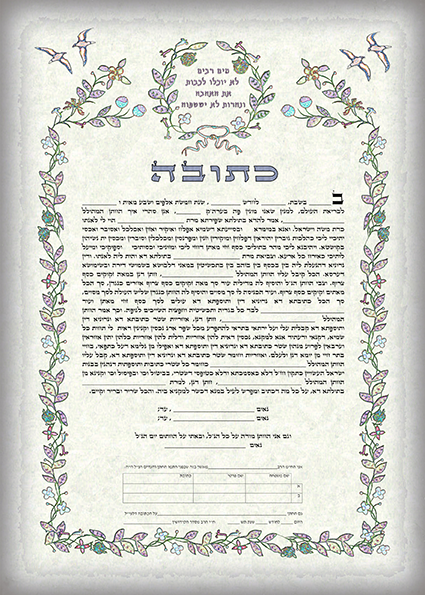
What's Shared with the Standard Orthodox Ketubah?
The Modern Orthodox ketubah preserves every halakhic requirement:
- Classical Aramaic text — the main ketubah obligation (200 zuz) plus the tosefet ketubah (additional sum)
- Two kosher witnesses — Shomer-Shabbat men, not relatives of either bride or groom
- Groom\'s signature, the blessing of erusin, and marriage according to the law of Moses and Israel
- The ketubah is given to the bride at the end of the chuppah and belongs to her
What Makes It Modern Orthodox?
Prenuptial agreement to prevent get-refusal — this is the central distinguishing feature. A separate document signed before the wedding, designed to prevent agunah situations should the husband later refuse to give a get (Jewish divorce). The agreement obligates the husband to pay daily compensation for every day of refusal, creating a meaningful financial incentive to act with integrity.
Two accepted versions:
- The "Mutual Respect" agreement of Tzohar — the main Israeli version, drafted with consensus among religious-Zionist rabbis
- The RCA Prenup (Rabbinical Council of America) — the American Modern Orthodox version, widely used in the US
Lieberman Clause — Rabbi Saul Lieberman (1898-1983) drafted in the 1950s a clause embedded in the ketubah itself, obligating the husband to appear before a beit din in case of separation. Its use has declined since the rise of external prenuptial agreements, but it is still used in some communities, particularly Conservative ones.
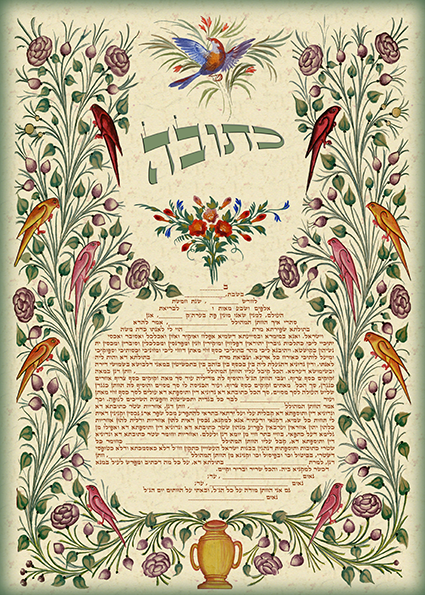
Design — What\'s Possible Within Halakhah?
Even a Modern Orthodox ketubah has wide room for beautiful design — as long as the halakhic text remains clear and readable:
- Traditional calligraphy in ktav STaM (sacred script) or scribal script
- Border ornamentation — flowers, pomegranates, vines, Jewish motifs
- Warm colors — gold, burgundy, blue, green
- Verses from Tanakh or midrash incorporated around the central text
- The rule: design must never interrupt, obscure, or confuse the Aramaic text
Who Signs What?
The ketubah itself: two kosher witnesses — Shomer-Shabbat men who are not relatives of either party. This is a meaningful difference from a Reform ketubah.
The prenuptial agreement: the groom, the bride, and sometimes a rabbi and witnesses — this document is signed separately, usually before the wedding at a meeting with the officiating rabbi.
Who Is It For?
A Modern Orthodox ketubah suits couples who:
- Are observant and want a fully halakhic marriage
- Are aware of the get-refusal issue and want preventive protection
- Are marrying through Tzohar or community rabbis who encourage prenuptial agreements
- Seek balance between tradition and values of equality within halakhah
Where to Turn?
- In Israel: Tzohar provides the "Mutual Respect" agreement and appropriate wedding ceremonies
- In the US: the RCA provides a standard prenup available in every Modern Orthodox community
- Always: consult your community rabbi before signing
How to Begin?
- Choose an officiating rabbi — one who supports prenuptial agreements
- Sign the prenup — before the wedding, usually at a preparation meeting
- Choose a ketubah design — view our catalog
- Personalize — incorporate favorite verses, meaningful motifs, and colors that speak to you. Contact us for details.
Frequently Asked Questions
Is a prenuptial agreement recognized by the Israeli Chief Rabbinate?
Yes. The Chief Rabbinate has acknowledged that the Tzohar "Mutual Respect" agreement does not compromise the halakhic validity of the wedding. The ketubah itself remains fully standard.
Doesn't this diminish the sanctity of the wedding?
On the contrary. Many rabbis see it as fulfilling "love your neighbor as yourself" - genuine mutual care for the spouse's wellbeing.
Who arranges this agreement?
The officiating rabbi, or a community rabbi affiliated with Tzohar/RCA. The agreement is signed before the wedding.
What is the difference between Tzohar and the Chief Rabbinate on this?
The Chief Rabbinate neither opposes nor mandates it. Tzohar leads the initiative and provides the agreement as a default.
How much does a designed Modern Orthodox ketubah cost?
Similar to a regular Orthodox ketubah - design and quality determine the price, starting at around 500 NIS. The prenuptial agreement itself is usually free through Tzohar.