A Reform wedding speaks its own language — one that expresses the value of equality between the partners. The Reform ketubah is not simply a document by which the husband makes a commitment to the wife; it is a mutual covenant between both partners. Designing such a ketubah requires sensitivity to a different text and to the values behind it.
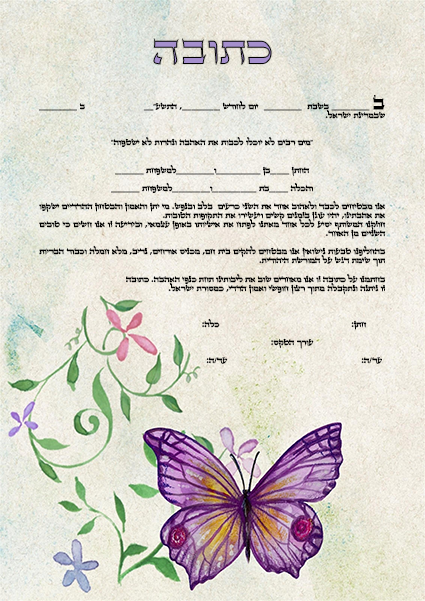
Key Differences from the Orthodox Ketubah
Language: Hebrew, and sometimes English or a combination — unlike the Orthodox ketubah, which is written in Aramaic.
Commitments: Mutual. Both the man and the woman commit to one another to love, respect, support, and be full partners in their shared life.
Witnesses: Still two adult witnesses, not family members (the halakhic rule that "relatives are disqualified from testimony" is preserved). The difference from the Orthodox ketubah: in Reform, women may serve as witnesses, as may witnesses who do not strictly observe a religious lifestyle.
Amount: Usually symbolic or not mentioned at all. The emphasis is on the relational message, not on the legal agreement.
Legal validity: A Reform ketubah is not recognized by the Chief Rabbinate of Israel. But it is a meaningful relational-values document, which many couples appreciate even more than the official one — precisely because of its message.
Common Texts
A classic Reform text in Hebrew (translated to English):
"On this day in this month of this year, by the count we count here in this city — we, [name] and [name], in love and mutual consent, promise one another to love and to respect, to support and to help, to be partners to each other in joy and in sorrow, in sickness and in health, all the days of our lives…"
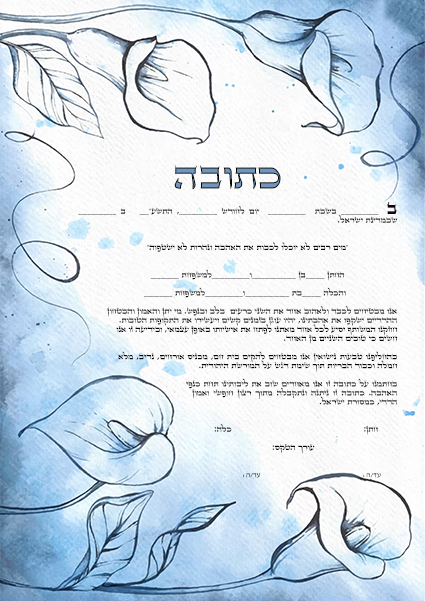
A contemporary English text:
"On this day, we, [names], promise each other our love and our partnership. We pledge to support and respect, to listen and to grow, to share our joys and our sorrows. Through every chapter of our life together, we choose each other again and again."
There are many additional variations — each couple may choose or adapt a text that reflects their own values and language.
Why Couples Choose a Reform Ketubah
The value of equality: A mutual ketubah expresses the understanding that this is two people entering a shared life by mutual choice — not an agreement of a man committing to a woman.
Emotional message: There is something different about a ketubah that speaks of love and hope, rather than only in legal terms.
Values alignment: Couples who do not wish their wedding ceremony to represent values that are not close to them find expression of themselves in the Reform ketubah.
Non-Orthodox wedding: When the wedding itself is not Orthodox — sometimes for reasons of religious denomination, a civil wedding abroad, or an interfaith wedding — the Reform ketubah is the natural choice.
Design — What Changes?
The Reform ketubah allows for greater design freedom:
- Inclusion of personal, non-religious symbols: flowers, birds, nature motifs, landscape illustrations
- Drawings of the couple themselves or of things meaningful to them
- Inclusion of poems, quotations, or additional texts that speak to the couple
- Freer design language — less bound to classical tradition
Displaying at Home
Since there is no involvement of the Rabbinate, the Reform ketubah often becomes a central piece of art in the home — displayed openly on the living room or bedroom wall, as a daily reminder of the promise that was made.
How to Begin?
- Choose a text — If you have a rabbi officiating your wedding, consult with them; otherwise, choose from accepted texts or compose your own.
- Match a design — Choose a design style that speaks to you. View examples in the catalog.
- Include personal elements — Symbols, colors, words that hold meaning for you.
- Consult with an artist — We tailor every detail of the ketubah to your values and style. To get in touch click here.
Frequently Asked Questions
Is a Reform ketubah recognized by the Israeli Chief Rabbinate?
No. The Chief Rabbinate in Israel recognizes only the Orthodox ketubah. A Reform ketubah is a meaningful relational-values document but is not officially registered.
Should we make both an Orthodox and a Reform ketubah?
Many couples do — an Orthodox ketubah for the Rabbinate ceremony, and a Reform designed ketubah for the personal relational message. You can also choose one design that works for both.
In what language is a Reform ketubah written?
Your choice — Hebrew, English, or a combination. Unlike the Orthodox ketubah, there is no requirement to write in Aramaic.
Who can serve as a witness on a Reform ketubah?
Two adult witnesses, not family members (this basic rule is preserved in Reform too). The difference from Orthodox: in Reform, women may serve as witnesses, as may witnesses who are not strictly observant.
How much does a designed Reform ketubah cost?
About the same as a designed Orthodox ketubah — design, style, and quality determine the price, not the halakhic content. Prices start at around 500 NIS.