One of the first questions every couple asks is: "Printed or handwritten?". It is important to understand from the start – this is not "high quality" vs. "basic." Both options are fully designed, artistic ketubot, with identical design quality, color richness, and attention to detail. The only difference is the production process – which affects price, timing, flexibility, and uniqueness. This guide will help you decide.
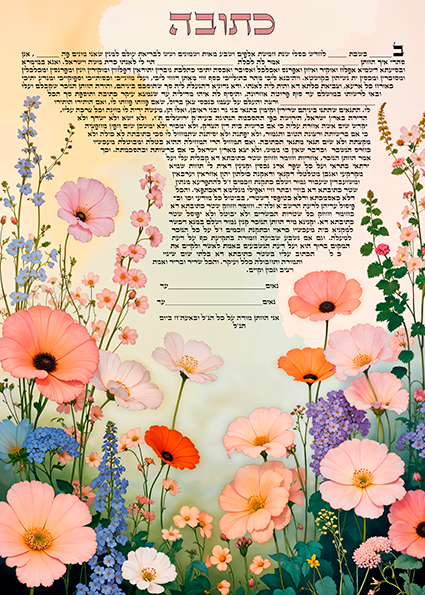
Printed Ketubah – The Democratization of Art
A printed ketubah begins exactly the same way as a handwritten one: an artist sits down, designs the work, colors it, and attends to every detail. The only difference is the final production – instead of a calligrapher writing each copy by hand, the original artwork is printed on high-quality artistic paper using advanced fine-art printing technology.
The main advantage: a couple who does not want or cannot invest thousands of shekels in a ketubah receives a complete, designed, colorful, and impressive piece of art at an accessible price. This is not a "compromise" – it is genuine art made accessible to every couple getting married.
- Paper quality: heavy artistic paper (200-300 gsm), archival-grade, long-lasting
- Printing: Giclée or advanced pigment printing – colors that last decades
- Personal signatures: the couple and witnesses sign by hand on the printed copy – a direct human touch on the artwork
- Multiple copies: couples sometimes order two copies – one for framing and another to keep safe
Text Flexibility and Digital Proofreading
With a printed ketubah, changing the text is simple and fast, and just as important – the couple receives a perfect digital file for proofreading before the ketubah is printed at all. The digital file allows:
- Personal details customization – names of the couple, parents\' names, date, place, amount – inserted precisely into the design
- Wording changes – adding a personal sentence, a favorite verse, or replacing a phrase – a matter of minutes, not weeks
- Bilingual ketubot – (Hebrew + English, Hebrew + Spanish, etc.) – easy to design, easy to update
- Digital proofreading before production – the couple receives a digital PDF file of the ketubah – exactly how it will appear once printed. They check on screen, at leisure, every letter, every vowel, every date. Only when everything is accurate and approved does the file go to print on the artistic paper. The first physical ketubah the couple holds is already the final, error-free ketubah.
- Last-minute corrections – found an error a week before the wedding? With a printed ketubah – file correction and reprint within a day or two
By contrast with handwritten: any change requires rewriting part or all of the ketubah. Proofreading before completion is also impossible – the sofer writes, and that is the final version. Many couples choose printing precisely for this peace of mind – they see in advance exactly what they are getting, approve it themselves, and know there will be no surprises under the chuppah.
Handwritten Ketubah – Unique Craftsmanship
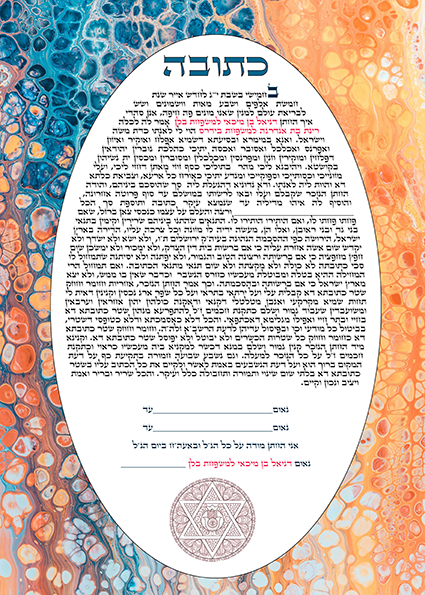
A handwritten ketubah is a completely one-of-a-kind work. A sofer (scribe) or calligrapher sits in the studio, dips the quill in ink, and writes letter by letter. The process takes 10 to 40 hours of work, depending on the text length and the calligraphy style.
No two copies will ever be identical. This is not a repetition of a template – it is genuine creation, with the small and delicate variations of the human hand, with the time and intention invested in it.
- Base material: klaf (parchment) or high-quality artistic paper
- Writing tool: a quill or modern calligraphy pen, with special ink
- Script styles: ktav STaM (traditional sofer\'s script), Beit Yosef, Ashkenazi script, or contemporary scripts
- Errors: hard to correct – an experienced sofer works slowly and with focus to prevent them in advance
The Halakhic Aspect
This is the most important section. Before deciding – find out what your community and officiating rabbi require:
- Strict approach (Haredi, some Sephardic communities): handwritten ketubah with special ink required. Some also require klaf (parchment). Printed ketubot are not accepted as the halakhic document.
- Accepted approach (Modern Orthodox, Religious Zionist): a printed ketubah is fully valid, as long as the text is precise and there are two kosher witnesses signing by hand.
- Non-Orthodox streams (Reform, Conservative): no requirement at all – printed and handwritten are entirely equal.
The golden rule: before ordering, ask the officiating rabbi. A two-minute answer can prevent awkwardness at the wedding.
Quick Comparison
| Parameter | Printed | Handwritten |
|---|---|---|
| Artistic quality | Identical | Identical |
| Price range | 500-2,000 NIS | 1,500-6,000 NIS |
| Production time | 3-7 days | 3-6 weeks |
| Proofreading before final | Digital file for approval | Not possible |
| Uniqueness | Identical to other copies of the same design | Completely one-of-a-kind |
| Error correction | Easy – reprint | Hard – requires manual work |
| Bilingual ketubah | Simple to design | Complex and expensive |
| Halakhic acceptance | Most communities | All communities |
The Hybrid Option – Best of Both Worlds
Not many know, but there is a middle path:
- Handwritten text + printed background: the calligrapher writes only the central halakhic text by hand, on a pre-printed designed background. Meets most halakhic requirements at a significantly lower price than a fully handwritten ketubah.
- Printed text + handwritten ornamentation: the text is printed with precision, but borders, flowers, and color are added by hand. Provides some uniqueness without the full price.
Both options are available at our studio upon request.
When to Choose Printed?
- Limited budget but you want real art in your home
- Tight timing (wedding in two weeks)
- Your community and rabbi accept a printed ketubah
- You want a bilingual ketubah or a personalized text
- Digital proofreading and seeing the final result in advance matters to you
- You want an additional copy for safekeeping / a second frame
When to Choose Handwritten?
- Uniqueness and once-in-a-lifetime craftsmanship matter to you
- Flexible budget
- You have time (a month or two before the wedding)
- Your community requires handwritten for halakhic reasons
- You have a deep connection to handcraft and tradition
Our Service – Without Bias
Both options are available at our studio – and we do not try to push you in one direction. Every design in our catalog has a price for printed and a price for handwritten. The choice is yours.
How to Begin?
- Ask your officiating rabbi – does your community accept printed?
- Check the budget – typical difference of 1,000-4,000 NIS between the options
- Choose a design – browse our ketubah catalog
- Get in touch – we will discuss your specific needs. Click here.
Frequently Asked Questions
Is a printed ketubah halakhically valid?
It depends on the community. In Modern Orthodox and Religious Zionist communities - fully valid as long as the text is precise and two kosher witnesses sign by hand. In Haredi communities and some Sephardic ones - handwritten is required. Ask your officiating rabbi before ordering.
Is the design quality of a printed ketubah inferior?
Absolutely not. Both options begin with the same design, the same colors, the same style. The only difference is the final production. A printed ketubah is a complete piece of art - simply at a more accessible price.
What is the price difference?
Printed ketubah: 500-2,000 NIS. Handwritten ketubah: 1,500-6,000 NIS. The gap reflects the sofer/calligrapher's work hours - 10-40 hours for a single handwritten ketubah.
Can we see the ketubah before it is printed?
For a printed ketubah - yes! We send you a precise digital file (PDF) for proofreading. You review on screen, approve, and only then we print. For a handwritten ketubah - this is not possible; the sofer writes and that version is final.
Is there a middle option?
Yes - a hybrid ketubah. Option 1: handwritten text on a printed background (meets stricter halakhic requirements, intermediate price). Option 2: printed text with handwritten ornamentation (partial uniqueness at a lower price). Both are available at our studio.