Couples whose partners come from different faith traditions marry all over the world – in the US, in Europe, and Israeli couples who travel abroad for civil weddings. For them, the ketubah is not just a halakhic text – it is a bridge between two traditions, two families, and two inner worlds. This page is for couples seeking a ketubah that speaks their language – without halakhic requirements that are not relevant to them, but with depth, beauty, and meaning.
The Reality in Israel and Worldwide
In Israel: the Chief Rabbinate does not officiate interfaith marriages. The common solution for Israeli couples is a civil wedding abroad – Cyprus, the Czech Republic, the US, or Prague – followed by registration at the Ministry of Interior. The marriage is recognized as a civil marriage in every respect.
Worldwide: in liberal Jewish communities (Reform, Conservative, Reconstructionist), interfaith weddings are held openly and respectfully. A rabbi officiates, sometimes alongside a spiritual leader from the other tradition.
Our focus: to give every couple a ketubah that reflects their unique identity – not a generic text, but a personalized document that honors both worlds.
Three Possible Approaches
A. Inclusive Jewish Approach
A Jewish framework that warmly welcomes the non-Jewish partner. The text is in Hebrew or English, with a Jewish spirit – but without the classical halakhic wording designed for a Jewish couple. The text emphasizes partnership, friendship, mutual commitment, and mutual respect.
Suitable for couples where one partner identifies as Jewish and the other respects the tradition and chooses to embrace elements of it.
B. Dual-Tradition Approach
Both traditions are present with equal respect – not one at the expense of the other. The combination can include:
- Symbols from both faiths: Star of David and cross, Star of David and crescent, Star of David and a Hindu symbol
- Text in two languages or more – Hebrew + the partner\'s language + English
- Verses from both sacred sources – from Tanakh alongside verses from the New Testament, the Quran, the Bhagavad Gita, or other texts
- Blessings in both languages – a Jewish blessing alongside one from the other tradition
C. Universal or Secular Approach
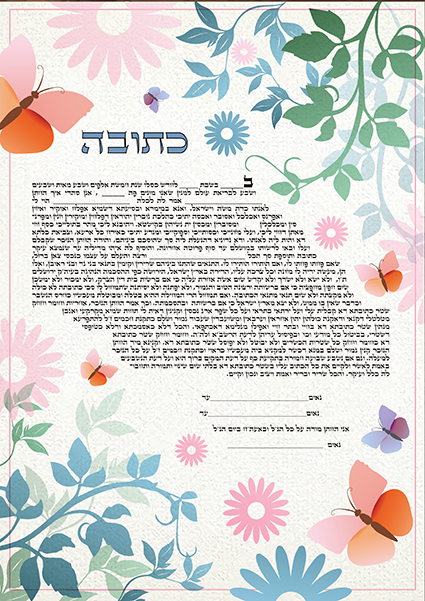
Without a religious framework – the language of love, commitment, and partnership. Suitable for couples whose identity is not essentially religious, but human and cultural. Allows complete creative freedom in design: nature symbols (trees, waves, birds), verses from world literature, or text the couple writes themselves.
Languages and Design
- Common languages: Hebrew + English, Hebrew + Spanish, Hebrew + Russian, Hebrew + French, Hebrew + Romanian
- Rarer languages: Hebrew + Arabic, Hebrew + Hindi, Hebrew + Chinese – we accommodate these with the help of a professional translator
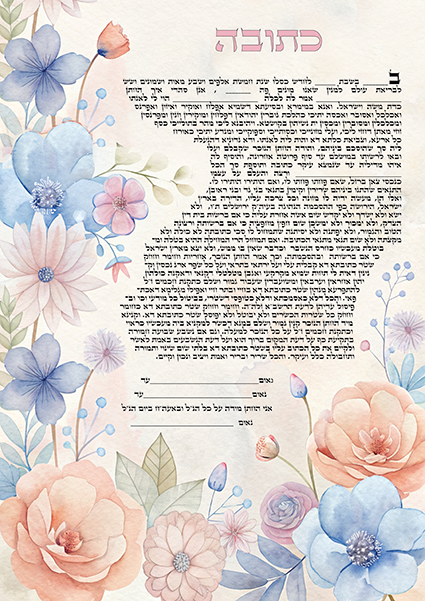
- Cultural symbols in place of (or alongside) religious symbols: trees of life, landscapes, birds, flowers, waves, mountains, moon, sun
- Color palette: more freedom to choose – no binding traditional requirements
- Style: modern, minimalist, or classical – according to the couple\'s taste
Who Writes? Who Signs?
The text writer: can be a Reform rabbi, a spiritual leader (minister, imam, liberal priest), a family member, or the couple themselves. We help coordinate – or you can bring the text ready.
Signing: witnesses from family and friends – there is no halakhic requirement for kosher witnesses. The signing is symbolic and legal-personal, attesting to the couple\'s consent.
The couple themselves: many couples choose to write the text together, as a meaningful relational process. We support this and help shape the final design.
What This Ketubah Says About the Couple
Interfaith couples who choose a ketubah are crafting a document that says:
- That they chose each other despite the differences – out of love, not under pressure
- That they are ready to build a new shared language – not abandoning who they are, but creating something new from both
- That they respect each other\'s background
- That they see love as a universal language that crosses cultural and religious borders
The Question of Registration in Israel
Important to understand: the ketubah is not a legal document in Israel. It is not submitted to the Rabbinate or registered at the Ministry of Interior. If the wedding took place abroad and was registered at the Ministry of Interior – the marriage is civilly valid, regardless of whether a ketubah exists.
The role of the ketubah is values-based and commemorative – a meaningful document that records the bond. Some couples say the ketubah became more meaningful to them than the official marriage certificate – because it expresses who they are, not just the fact that they married.
Our Process
- Initial conversation – we listen about both partners, the cultural background, and what matters to you
- Choosing an approach – Inclusive Jewish / Dual-Tradition / Universal – depending on who you are
- The text – bring it ready, get a template, or write it together with us
- Design – combining symbols, languages, and colors that speak to you
- Digital proofreading – review on screen before final production
- Delivery – a printed or handwritten ketubah, ready for your chuppah or ceremony
How to Begin?
- Get in touch – briefly describe the couple and the background. Click here
- We suggest an approach – based on your needs
- We design together – a ketubah that reflects both of you
- You can view more examples in our catalog
Frequently Asked Questions
Is the ketubah legally valid in Israel?
No - the ketubah is not a legal document in Israel for any couple. The marriage itself is civilly valid if performed abroad and registered at the Ministry of Interior. The ketubah is a values-based and commemorative document only.
Does this also suit couples where one is a secular Jew?
Absolutely. The three approaches we offer also suit couples where one or both partners identify as secular Jews. The universal approach in particular is very popular with such couples.
Can we include Christian, Muslim, or Hindu symbols in the ketubah?
Yes. In the dual-tradition approach, combining symbols from the second faith is part of the beauty. We draw such symbols with sensitivity, taking care to honor their meaning in each tradition.
What if one partner wants to convert to Judaism later?
Then you will later need a new ketubah - a full halakhic ketubah after the conversion. The first interfaith ketubah will remain as a record of your journey, and the new one will be the official rabbinic ketubah.
In what language can it be written?
Almost any language - Hebrew, English, Spanish, Russian, French, Romanian, Arabic, Hindi, and other languages with a translator's help. The most common combination is Hebrew + the partner's language + English as a universal language.